
Working closely
with


"As I argue in my latest book, the route to Fraserburgh should have been rationalised and developed as a key link for Buchan. Today, a new railway to Peterhead and Fraserburgh should be Scotland’s top-priority rail re-opening."
- David Spaven, author, transport consultant and rail industry expert.

In partnership with

1. Extending the East Coast Main Line to Peterhead and Fraserburgh

CNER are campaigning to extend the East Coast Line northwards from Aberdeen, through Ellon and Peterhead to ultimately terminate at Fraserburgh. Our proposed railway is not simply a reopening, rather, we propose combining the former Formartine and Buchan route with new sections to create a modern railway that is suited to serve the modern day needs of Buchan. This new rail link will revive an area that has been isolated from the wider network for decades.
The Borders Railway "breathed new life" into towns along the length of it's route. Better connections drove people into the local area, and the ease of access boosted businesses and revived their town centres. The link has become a lifeline service for people seeking to access education and healthcare services. Railways literally put places on the map, bring people closer together, and improve quality of life anywhere they are introduced. The Borders Railway has been a success in every measurable way, the case for Buchan is remarkably similar, Scotland's next new railway is here.
The Buchan Coast produces a diverse range of produce including beer, fish, ice cream, grain, seed potatoes, and oil and gas materials. Most of these products are perfect candidates for rail freight, they’re bulky, and are transported regularly over long distances. The most recent study supports the proposal that there is enough suitable freight to support terminals in Ellon and Peterhead. Intermodal freight trains will remove HGVs from the roads every single day, improving safety, making journey times predictable, and saving tonnes of Carbon. This in turn will alleviate the pressure on our roads, providing room for existing businesses to grow, making shipping times reliable and improving the appeal of the region to new industry.

Serving and enabling the journeys that people actually make.
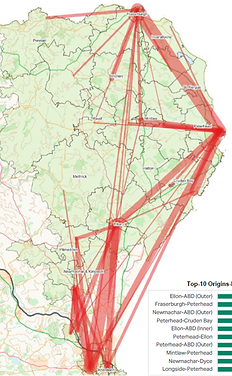
One of the most frequently made journeys in the region is between Fraserburgh and Peterhead, recently singled out as one of Scotland's worst bus routes for reliability. Bringing these towns closer together by providing a rail link will be truly transformative. The reports conclude that this railway will remove 28 million car kms, and 36 million lorry kms from the roads every single year once the scheme reaches maturity. With modal shift like this, savings in CO2 emissions are measured in the hundreds of millions of tonnes. Additionally, analysis predicts that opening the new link could reduce serious or fatal accidents by 75% on these very roads that people use the most. Fundamental to these proposals is the retention of the Formartine and Buchan Way as a cycle path. Let us be clear, CNER will never consider removing the existing cycle path from the community. Where the new railway follows the historic route, the cycle path will be retained alongside the railway. Elsewhere, the railway will deviate from the cycle path, allowing the FBW to be enjoyed as it is today.

What progress has been made?

The Proposal
3 Key projects that will unlock the potential of the North East of Scotland.
1. Extending the East Coast Main Line to Peterhead and Fraserburgh
CNER are campaigning to extend the East Coast Line northwards from Aberdeen, through Ellon and Peterhead to ultimately terminate at Fraserburgh. Our proposed railway is not simply a reopening, rather, we propose combining the former Formartine and Buchan route with new sections to create a modern railway that is suited to serve the modern day needs of Buchan. This new rail link will revive an area that has been isolated from the wider network for decades.
The Borders Railway "breathed new life" into towns along the length of it's route. Better connections drove people into the local area, and the ease of access boosted businesses and revived their town centres. The link has become a lifeline service for people seeking to access education and healthcare services. Railways literally put places on the map, bring people closer together, and improve quality of life anywhere they are introduced. The Borders Railway has been a success in every measurable way, the case for Buchan is remarkably similar, Scotland's next new railway is here.
The Buchan Coast produces a diverse range of produce including beer, fish, ice cream, grain, seed potatoes, and oil and gas materials. Most of these products are perfect candidates for rail freight, they’re bulky, and are transported regularly over long distances. The most recent study supports the proposal that there is enough suitable freight to support terminals in Ellon and Peterhead. Intermodal freight trains will remove HGVs from the roads every single day, improving safety, making journey times predictable, and saving tonnes of Carbon. This in turn will alleviate the pressure on our roads, providing room for existing businesses to grow, making shipping times reliable and improving the appeal of the region to new industry.
Serving and enabling the journeys that people actually make
One of the most frequently made journeys in the region is between Fraserburgh and Peterhead, recently singled out as one of Scotland's worst bus routes for reliability. Bringing these towns closer together by providing a rail link will be truly transformative. The reports conclude that this railway will remove 28 million car kms, and 36 million lorry kms from the roads every single year once the scheme reaches maturity. With modal shift like this, savings in CO2 emissions are measured in the hundreds of millions of tonnes. Additionally, analysis predicts that opening the new link could reduce serious or fatal accidents by 75% on these very roads that people use the most. Fundamental to these proposals is the retention of the Formartine and Buchan Way as a cycle path. Let us be clear, CNER will never consider removing the existing cycle path from the community. Where the new railway follows the historic route, the cycle path will be retained alongside the railway. Elsewhere, the railway will deviate from the cycle path, allowing the FBW to be enjoyed as it is today.
What progress has been made?
CNER partnered with the Aberdeen & Grampian Chamber of Commerce to deliver the Buchan Sustainable Transport Study, funded by an award from the Scottish Government's Just Transition Fund. AECOM and Stantec were commissioned to undertake the work, and over a period of 10 months, produced two reports which together form the Buchan Sustainable Transport Study, which was delivered and submitted to the Scottish Government in June 2024. The success of the BSTS demonstrates that CNER spent the public money awarded to us by the JTF responsibly, producing a body of work in an accelerated period of time that lays an evidential foundation for extending the East Coast line northwards. The Buchan Sustainable Transport Study comprises two thirds of the analysis required to form an Outline Business Case. Additional work is being undertaken by NESTRANS in the meantime, and CNER are entering this election seeking funding for the final stage - a Detailed Options Appraisal. This will allow this project to be debated in the Scottish Parliament, and spades to be in the ground within this Parliamentary term (5 years).

2. Fulfilling the long promised Aberdeen Intercity Rail Improvements
2a. Aberdeen to the Central Belt - 10 years later, far overdue.

In 2016 the Scottish Government promised to reduce journey times between Aberdeen and the Central Belt by at least 20 minutes. These enhancements are part of a package of upgrades that are vital in modernising connections to and from the North East. Further delay in completing the programme risks leaving our region at a disadvantage at the precise moment we are facing so many other challenges brought on by the decline in the Oil and Gas industry and the slow build out of a transition. Last year, facing budget pressures, the Scottish Government decided to do just that. The programme was delayed. Today, Network Rail have a completed design and costed plan for implementation, Transport Scotland have approved that plan in principle, but have yet to approve funding for Network Rail to progress with the plan. Works have been permitted on sections between Arbroath and Dundee, but the remainder of the project, particularly north of Arbroath has been indefinitely delayed.
For the North East, this project is so much more than simply time savings. Closing Victorian-era semaphore signal boxes and replacing them with modern 'track circuit' signalling will vastly improve the resilience of the line, meaning trains will no longer suffer as much from stacked up delays caused by a train in front knocking on to the trains behind. Services will be able to get back on track quickly, and the timetable will be much more reliable throughout the day. Repairing, strengthening, widening and in places replacing old lineside features along the length of the line will reduce the strain on maintenance teams and add to the cumulative effect on the resilience of the line. Bringing the line up to modern gauge standards will allow wider freight wagons to be carried on the railway, reducing the number of HGVs on the road by shifting these loads to rail freight. New platforms at Arbroath and Montrose, and passing loops up and down the line will allow local services to get out of the way of express services. This will result in faster and more reliable journey times, particularly for commuter and business travellers, but these passing loops will also allow for step change in the quantity of rail freight carried on the line. Currently, this is a major problem - sources tell CNER and AGCC that their companies want to ship by rail from Aberdeen, but Network Rail cannot meet capacity.

A key element of the Aberdeen to Central Belt (A2CB) Service Improvement Project are upgrades to Aberdeen Station itself. Platform 8 in Aberdeen has been out of use for more than three decades now. With ever increasing passenger demand for rail travel in that period, Aberdeen Station has become quite congested. Today over 80 hours of shunts (where a driver moves an empty train out of the way such that another train can use the platform) are required every week just to keep the existing services moving. These upgrades are critical for the future of the North East, another through service will reduce the need for such shunts, delivering efficiency immediately for the Scottish Government, as well as providing room for growth in both passenger and rail freight services.
2b. Aberdeen to Inverness - Phase 1 complete, Phase 2 MIA

In 2019 Network Rail completed a range of improvements on the line between Aberdeen and Inverness, including new stations at Inverness Airport and Kintore, redoubling between Aberdeen and Inverurie, and re-signalling at Elgin and Forres. At the time, these upgrades were described as 'Phase 1' of a wider Aberdeen to Inverness enhancement programme, with 'Phase 2' still being in the planning stages, but ultimately having the goal of bringing journey time on the A-I line down to 1:59 or faster.
Today however, it is difficult to find any mention of a 'Phase 2 ' of this project anywhere. The Aberdeen to Inverness line is mostly single line, slow, regulated by Victorian-era semaphore signals. and manned rural signal boxes, some sections even still utilise antiquated short weld rails. This meandering route between Scotland's two most northern cities is not fit for purpose as a main line intercity railway. East - West links should be as important as North - South ones. Upgrading the Aberdeen - Inverness line will provide a step change for the north of Scotland.
Reducing travel time below the 2 hour mark delivers enormous leaps forward in efficiency for the Scottish Government too. As you may expect, working time regulations limit the amount of safety critical work that train crew can do in any one day. Sub-two hour journey times would mean Scotrail train crews would be able to complete two trips between Aberdeen and Inverness in a working day. This would be transformative - the existing timetable could be operated with half of the currently required staff, freeing these workers up for other tasks, providing resilience for the rest of timetable, or, to operate additional services.

3. New stations at Cove Bay and Newtonhill.


Dyce Station Re-opening, 1984
Cove Bay Station site, Today

On the northern edge of Aberdeen city limits lies Dyce railway station. In recent years, Alex Hynes, former MD of Scotrail, chose Dyce as an example of a once "perfect station". He reasoned that being located within a sizeable population centre, and on the edge of a growing industrial zone resulted in full trains all day heading in both directions. The next station on the line is Kintore, newly reopened in 2020, it has proven itself successful - several years on has become an integral part of the community's transport system.
Dyce and Kintore have been a success in the north of Aberdeen, now Cove and Newtonhill are primed to replicate that success to the south of the city. Newtonhill is a town of similar size and distance from Aberdeen as Kintore, and can be added to the roster of stops that Inverurie - Montrose local services make with zero disruption. Local residents are calling out for this station to go ahead, and for their needs surrounding the placement of a car park to be met.
Cove Bay station will be the North East's next "perfect station". Located on the southern most edge of Aberdeen city limits, it's population is larger than
Dyce, and larger than Winchburgh, which most recently had a new railway station approved. The proposed location of Cove Bay's new station however will allow for commuting to Aberdeen's burgeoning Energy Transition Zone (ETZ). This pocket of land has been set aside for companies to invest in work that will contribute to Scotland's Just Transition. So, as Dyce supported the Oil and Gas industry to gain a foothold locally, in the process providing thousands of jobs, Cove Bay has the opportunity to do the same for Scotland's Renewables Industry. Both of these stations have completed the Detailed Options Appraisal with a positive result, nothing further stands in the way of these stations beginning construction except ministerial approval. We call on the next Transport Minister to approve Cove Bay and Newtonhill for new stations as one of their first tasks in their new role.

Proposed Cove Bay Station site, Circled in red.